

Agricultural Water Quality Testing Methods
A field can look well designed on paper and still underperform because the water chemistry was never checked closely enough. That is why agricultural water quality testing methods matter so much. A marginal water source may still be usable, but only if the risks are identified early and managed with the right irrigation, fertigation, and treatment decisions.
Why agricultural water quality testing methods matter
Water quality affects much more than plant hydration. It influences infiltration, emitter performance, nutrient availability, root health, soil structure, and even the compatibility of fertilizers and crop protection materials. In practical terms, poor water quality can reduce yield slowly and quietly, long before obvious visual symptoms appear.
The challenge is that there is no single test that tells the whole story. A water source can be acceptable in terms of salinity but problematic in terms of bicarbonates. It can be microbiologically clean for one use and still unsuitable for another. This is why agricultural water quality testing methods should always be selected based on the crop, irrigation system, source type, and intended use of the water.
Start with the right sampling approach
Before discussing laboratory parameters or field instruments, it is worth emphasizing a simple truth: bad sampling leads to bad decisions. The sample must represent the water that is actually reaching the farm or field. Testing a reservoir surface sample when the irrigation pump draws from deeper water can be misleading. The same applies when testing a canal during low demand, then irrigating later under very different flow conditions.
Sampling should account for source variability. Wells are often more stable than rivers, canals, or recycled water, but they can still shift seasonally or as pumping patterns change. Surface water typically requires more frequent monitoring because rainfall events, upstream discharges, sediment movement, and biological activity can change quality quickly.
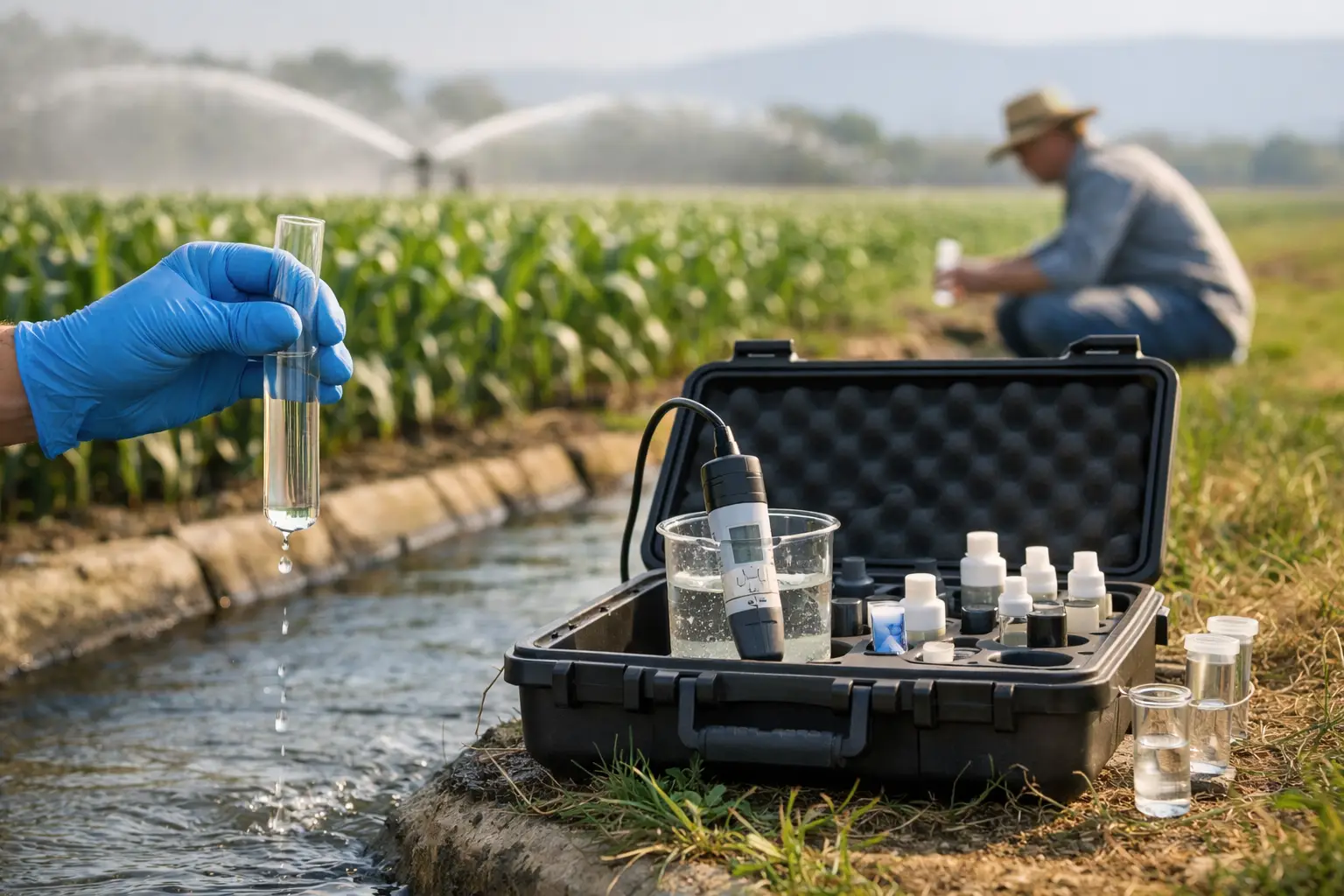
Clean sampling containers, proper preservation, and fast delivery to the laboratory are essential. For some parameters, such as pH and electrical conductivity, field measurement is often preferred because values can change during transport or storage.
The core testing methods used in agriculture
Field measurements for rapid screening
Portable meters are often the first line of assessment. Electrical conductivity, pH, temperature, and sometimes dissolved oxygen can be measured on site. These tests are relatively fast, affordable, and useful for routine monitoring.
Electrical conductivity is a practical indicator of total dissolved salts. It does not identify which salts are present, but it gives a quick sense of salinity risk. For growers, this matters because salinity affects osmotic stress, crop tolerance, and long-term soil management. A stable EC trend may be acceptable even if the value is not ideal, while a rising trend during the season can require immediate adjustment.
pH is also routinely measured in the field, especially where fertigation is used. Water pH alone does not define suitability, but it provides context for nutrient solubility, chemical compatibility, and treatment needs. High pH water often points toward bicarbonate and carbonate concerns, especially in drip-irrigated systems.
Laboratory chemical analysis
Laboratory testing remains the backbone of agricultural water quality evaluation. A standard chemical analysis usually includes major cations such as calcium, magnesium, sodium, and potassium, along with major anions such as chloride, sulfate, bicarbonate, and carbonate. It may also include nitrate, boron, iron, manganese, and other elements depending on the source and crop sensitivity.
This method provides the detail needed to interpret water behavior in the field. For example, sodium concentration alone is not enough. It must be evaluated in relation to calcium and magnesium to estimate sodicity risk, typically through sodium adsorption ratio. This is especially important where soil structure and infiltration are already sensitive.
Bicarbonate deserves special attention in many irrigation systems. Elevated bicarbonate can contribute to precipitation of calcium and magnesium, increase clogging risk, and complicate nutrient management. In greenhouse production and high-frequency drip irrigation, even moderate bicarbonate levels can become operationally expensive.
Micronutrient and trace element testing is more situation-dependent. Boron is a common concern because crops differ widely in tolerance. A water source that is acceptable for one crop can be damaging for another. Iron and manganese may not always create direct crop toxicity, but they can promote emitter clogging and interfere with water treatment strategies.
Microbiological testing
Microbiological water testing is essential when water may contact edible plant parts, when reclaimed water is used, or when storage conditions encourage biological growth. Common tests include total coliforms, E. coli, and other indicators depending on regulatory and operational needs.
For irrigation managers, microbiological quality is not only a food safety issue. Biological load also affects filtration performance, biofilm formation, and emitter clogging. Surface water sources and reservoirs are particularly vulnerable to these problems, especially under warm conditions with high nutrient availability.
Physical testing for suspended solids and turbidity
Physical water quality parameters are sometimes overlooked until filtration problems appear. Total suspended solids, turbidity, and sediment load are important for system design and maintenance. They are especially relevant for drip and micro-irrigation systems, where fine particles can gradually reduce uniformity.
These tests help determine whether the problem is mainly chemical, physical, or biological. That distinction matters because treatment options differ. Acid injection may address carbonate precipitation, but it will not solve a sediment problem coming from an unprotected surface source.
Matching the method to the production system
Not every farm needs the same testing package. A field crop operation using sprinkler irrigation from a stable well may rely on periodic chemical analysis and routine EC monitoring. A greenhouse operation using drip irrigation, fertigation, and acid dosing needs tighter control and more frequent testing because small errors create fast consequences.
Crop sensitivity also changes the testing strategy. Leafy vegetables, berries, citrus, and nursery crops can respond very differently to salinity, chloride, sodium, or boron. Water that works for forage may be unacceptable for a high-value horticultural crop. The method is not only about how to test. It is also about what level of precision is needed for the business and agronomic risk involved.
How to interpret the results correctly
One of the most common mistakes in agricultural water quality testing methods is evaluating each parameter in isolation. Water quality is an interacting system. A sodium issue cannot be judged without considering calcium, magnesium, and soil texture. A high pH reading is only partially useful without alkalinity data. A filtration problem may involve both suspended solids and microbial growth.
Interpretation should connect water quality to three practical questions. First, what will happen in the soil? Second, what will happen inside the irrigation system? Third, what will happen in the fertilizer tank and root zone? If the analysis does not answer those questions, it is incomplete from a management perspective.
This is where experienced agronomic interpretation adds value beyond the lab report. Two water sources may show similar EC values but create very different field outcomes because of ion composition, blending practices, irrigation frequency, and drainage conditions.
Frequency of testing depends on source stability
A one-time analysis is rarely enough. Stable groundwater may be tested less frequently, often once or twice a year unless there are known issues. Surface water, blended sources, reclaimed water, and seasonal supplies usually need more frequent monitoring.
Testing should also be event-based. If a new well comes online, a filtration issue appears, a fertilizer program changes, or crop symptoms emerge unexpectedly, water quality should be reassessed. The cost of testing is modest compared with the cost of clogged emitters, reduced uniformity, nutrient precipitation, or avoidable yield loss.
Common trade-offs and practical limits
There is always a balance between testing depth and operational budget. Full laboratory panels provide strong decision support, but routine monitoring with handheld tools is still valuable when budgets are tight. The key is not to confuse screening with diagnosis. A portable meter can show that something changed, but usually not why.
Another trade-off involves treatment. Some water quality problems can be corrected economically, while others are better managed through crop choice, blending, irrigation scheduling, or soil amendments. For example, highly saline water may still be workable in a well-drained system with tolerant crops, while moderate bicarbonate in a drip system may justify acidification because the operational benefits are immediate.
Where water quality is marginal, testing should not be viewed as a compliance exercise. It is a management tool. That perspective is central to effective agronomy and to the kind of evidence-based decision-making organizations like Cropaia emphasize in both advisory work and technical training.
Building a useful water testing program
A strong program usually combines baseline laboratory analysis, routine field measurements, and periodic review of irrigation system performance. When growers track water quality together with soil test data, leaf analysis, clogging frequency, and crop response, they move from reactive troubleshooting to real control.
The best agricultural water quality testing methods are not necessarily the most complex. They are the ones that generate reliable information, at the right frequency, and lead to decisions that improve yield, efficiency, and system reliability. Good testing does not eliminate every water problem, but it prevents guesswork from becoming the most expensive input on the farm.
Water quality rarely announces itself with a single clear symptom. It usually shows up as lower uniformity, harder fertigation management, slower infiltration, or crop performance that never quite reaches its potential. Testing gives those hidden constraints a name, and once they are named, they can be managed.








About Post Author
