


How to Calculate Crop Nutrient Requirements
A fertilizer program starts going off track long before symptoms appear in the field. By the time leaf yellowing, weak growth, or uneven canopy development are visible, yield potential has usually already been reduced. That is why knowing how to calculate crop nutrient requirements is not a paperwork exercise. It is a core management skill that affects yield, quality, input efficiency, and risk.
The calculation itself is straightforward in principle, but good nutrient planning depends on using the right assumptions. Crop demand, soil supply, irrigation water quality, nutrient recovery efficiency, and target yield all interact. If one of those pieces is wrong, the final recommendation can be too high, too low, or poorly timed.
How to calculate crop nutrient requirements step by step
At the field level, crop nutrient requirement is not simply the amount of fertilizer to apply. It is the crop’s total nutrient demand minus the nutrients the field can already supply, adjusted for how efficiently the crop will recover applied nutrients.
A practical way to express it is:
Fertilizer nutrient needed = Crop nutrient demand – Soil and water nutrient supply / Expected nutrient use efficiency
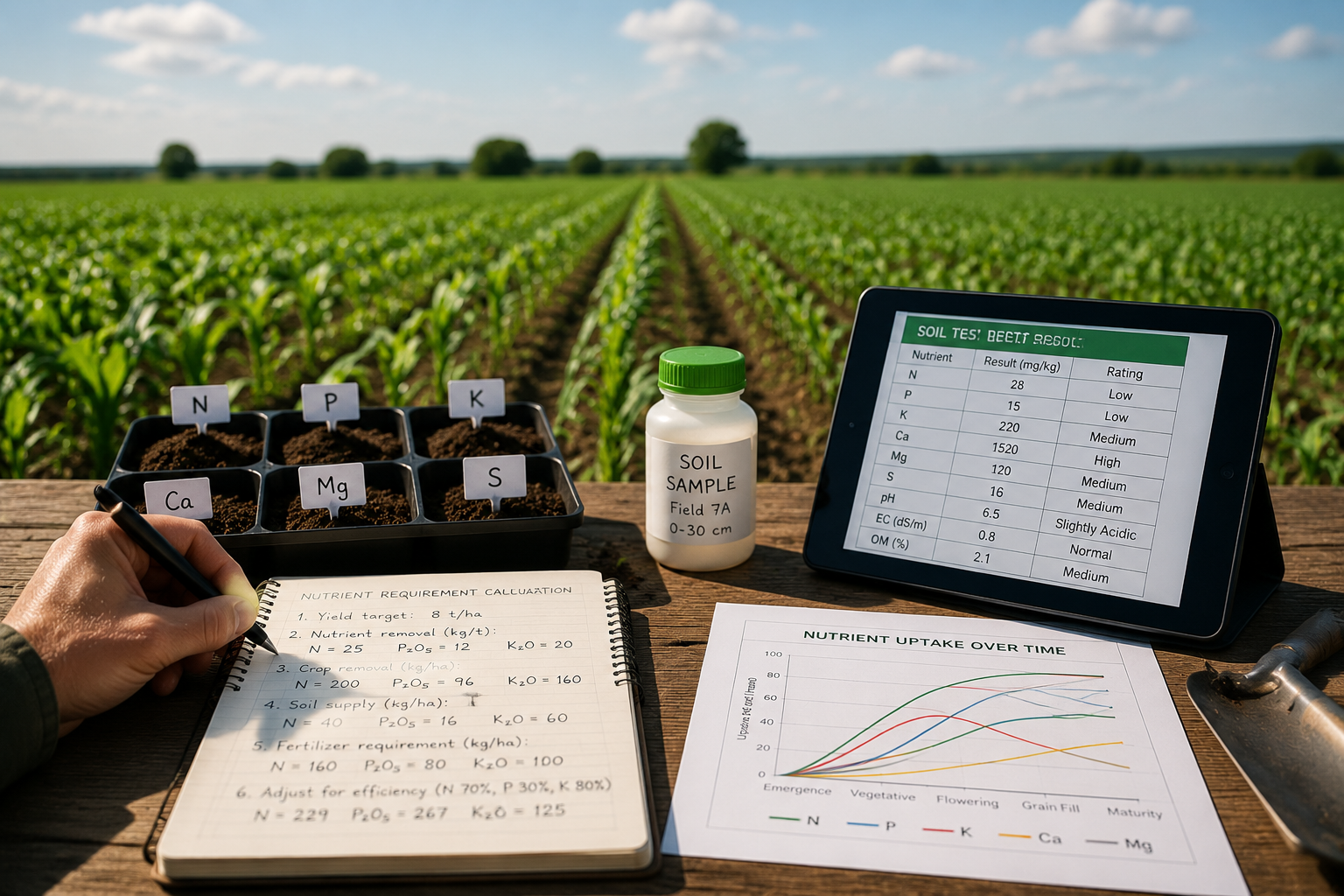
In real farm planning, it is usually better to think through this in stages rather than rely on a single equation. Start with the crop and yield target. Then estimate total nutrient uptake or removal. After that, account for nutrient contributions from soil, irrigation water, organic amendments, and previous crop residues. Finally, adjust for recovery efficiency and application method.
Step 1: Define a realistic yield target
Everything begins with yield target. If the target is unrealistic, the nutrient plan will be unrealistic too. A target based on best-ever production in an exceptional season often leads to over-fertilization. A target based on an average poor year may underfeed a high-potential field.
The better approach is to use recent field history, cultivar potential, planting date, climate, irrigation capacity, and management level. For commercial operations, a realistic target is often a high-probability yield under good management, not a theoretical maximum.
For example, if a corn field has produced between 185 and 210 bushels per acre under irrigation, setting a target of 200 bushels may be reasonable. If irrigation is limited or planting is late, that target should be adjusted downward. Nutrient recommendations that ignore these practical limits tend to waste money.
Step 2: Estimate total crop nutrient demand
Once the yield target is defined, estimate how much nitrogen, phosphorus, potassium, and other nutrients the crop needs to produce that yield. This can be based on published crop uptake values, nutrient removal coefficients, or local research data.
There is an important distinction here. Some crops are fertilized based on total uptake, while others are managed more closely around nutrient removal in the harvested portion plus a margin for field efficiency. The right approach depends on the nutrient and crop system.
Nitrogen usually requires the most careful attention because it is highly dynamic in the soil. For N, many agronomists estimate total crop demand rather than just harvested removal. Phosphorus and potassium are often assessed using removal rates together with soil test interpretations, especially in annual row crops. In fruit, vegetable, and perennial systems, uptake curves and stage-specific demand are often more useful than simple removal numbers.
Suppose a crop is expected to remove 0.8 pounds of P2O5 and 1.1 pounds of K2O per unit of harvested yield. If the target is 10 units, then estimated removal is 8 pounds of P2O5 and 11 pounds of K2O. If local data show that actual seasonal uptake is higher than removal because significant nutrients remain in vegetative biomass, that should be considered in the fertilizer strategy.
Step 3: Measure what the soil can already supply
This is where many errors begin. A crop requirement is not the same as a fertilizer requirement because the soil already contributes nutrients. Soil testing is essential for phosphorus, potassium, calcium, magnesium, sulfur in some situations, micronutrients where relevant, and for assessing pH, salinity, and other conditions that affect availability.
For nitrogen, the picture is more complex. A standard soil test does not always predict total seasonal N supply well because mineralization, leaching, irrigation management, residue breakdown, and temperature all influence availability. In some systems, pre-plant nitrate tests, in-season tissue analysis, or local N budgeting tools are more reliable than a single soil sample.
Soil organic matter also matters, but it should not be treated as a precise fertilizer credit without local calibration. A field with moderate organic matter may mineralize a useful amount of nitrogen, but the exact contribution depends on moisture, temperature, aeration, and biological activity. The same field may behave differently across seasons.
How to calculate crop nutrient requirements with all nutrient sources included
A sound calculation includes every meaningful nutrient source, not just bagged fertilizer. That means irrigation water, manure, compost, biosolids, and crop residue credits where appropriate.
Irrigation water is often overlooked, especially for nitrate, calcium, magnesium, and sulfur. In high-volume irrigation systems, nutrient contribution from water can be agronomically significant. If a water source contains 10 ppm nitrate-nitrogen and seasonal irrigation is substantial, that nitrogen input should be included in the balance.
Organic amendments can also supply major nutrient amounts, but their availability is rarely immediate or complete. Total nutrient content is not the same as plant-available nutrient in the current season. For manure and compost, availability depends on source, moisture content, carbon-to-nitrogen ratio, application timing, and incorporation. Conservative availability estimates are usually more reliable than assuming full release.
Previous crop residues can contribute nitrogen, particularly after legumes, but the actual credit depends on biomass, residue management, and decomposition conditions. A blanket credit without field-specific context can mislead fertilizer planning.
Step 4: Adjust for nutrient use efficiency
After estimating crop demand and subtracting field nutrient supply, adjust for nutrient use efficiency. This is one of the most important and most neglected parts of the calculation.
If a crop needs 100 pounds of available nitrogen from fertilizer, that does not necessarily mean applying 100 pounds of N. If only 70 percent of the applied nitrogen is expected to be taken up because of timing losses, leaching, denitrification, or volatilization, then the application rate needs to be higher to deliver the required amount to the crop.
The same principle applies to phosphorus and potassium, although the mechanisms differ. Banding phosphorus often improves early availability in cool soils. Split nitrogen applications can improve recovery compared with a single pre-plant dose. Fertigation can raise efficiency substantially when scheduling is aligned with crop demand and root activity.
Efficiency depends on source, placement, timing, irrigation uniformity, soil texture, root health, and weather. There is no universal efficiency value that fits every field. A well-managed drip-fertigated vegetable crop may recover nutrients far more efficiently than a broad-acre field receiving surface-applied fertilizer before heavy rain.
Step 5: Match supply to crop uptake timing
A correct seasonal total can still fail if nutrients are applied at the wrong time. Crops do not absorb nutrients evenly from planting to harvest. Demand rises sharply during specific growth stages, and nutrient availability must align with that pattern.
Nitrogen and potassium are especially sensitive to timing in many crops. Too much early application can increase losses and excessive vegetative growth. Too little during peak demand can reduce yield or quality even if the seasonal total appears adequate on paper.
This is why nutrient requirement calculations should lead to a program, not just a number. The annual total should be divided into applications that reflect crop growth stage, rooting depth, irrigation capacity, and field access. In perennial crops, reserve dynamics and post-harvest nutrition also need to be considered.
A simple example of the calculation
Assume a tomato field has a target yield that requires 180 pounds of nitrogen per acre for the season. Pre-plant soil and water assessment suggests the field will supply 40 pounds of available N. That leaves 140 pounds to be provided through fertilizer.
If the planned application method and field conditions are expected to deliver 80 percent nitrogen use efficiency, the fertilizer N requirement is 140 divided by 0.80, which equals 175 pounds of N per acre.
That does not mean 175 pounds should be applied at planting. It means the seasonal program should be designed to deliver that amount through well-timed applications, with adjustments based on in-season monitoring.
Common mistakes when calculating crop nutrient requirements
The most common mistake is treating published fertilizer recommendations as fixed rules. Reference tables are useful starting points, but they do not replace soil tests, local conditions, or field history.
Another common problem is confusing nutrient form with nutrient amount. A grower may know the product rate per acre but not the actual pounds of nutrient delivered. This becomes especially risky when comparing fertilizer sources or combining dry and liquid materials.
Ignoring pH, salinity, root stress, or poor irrigation uniformity is another major issue. A mathematically correct nutrient plan can still perform poorly when field conditions reduce uptake. Nutrient requirement calculations should always be interpreted in the context of crop health and root-zone conditions.
Finally, many programs fail because they are not updated in season. Nutrient planning should start before planting, but it should not end there. Tissue analysis, petiole sap testing in some crops, growth observations, and revised yield expectations all help refine the program. This is where unbiased agronomic interpretation matters more than generic recommendations.
The best nutrient plans are not the most aggressive. They are the most accurate. When you calculate requirements from realistic yield targets, verified soil and water data, and field-specific efficiency assumptions, fertilizer decisions become more precise and more defensible. That is how better nutrition management supports stronger yields, better input efficiency, and more confident agronomic decisions in the field.












About Post Author
