

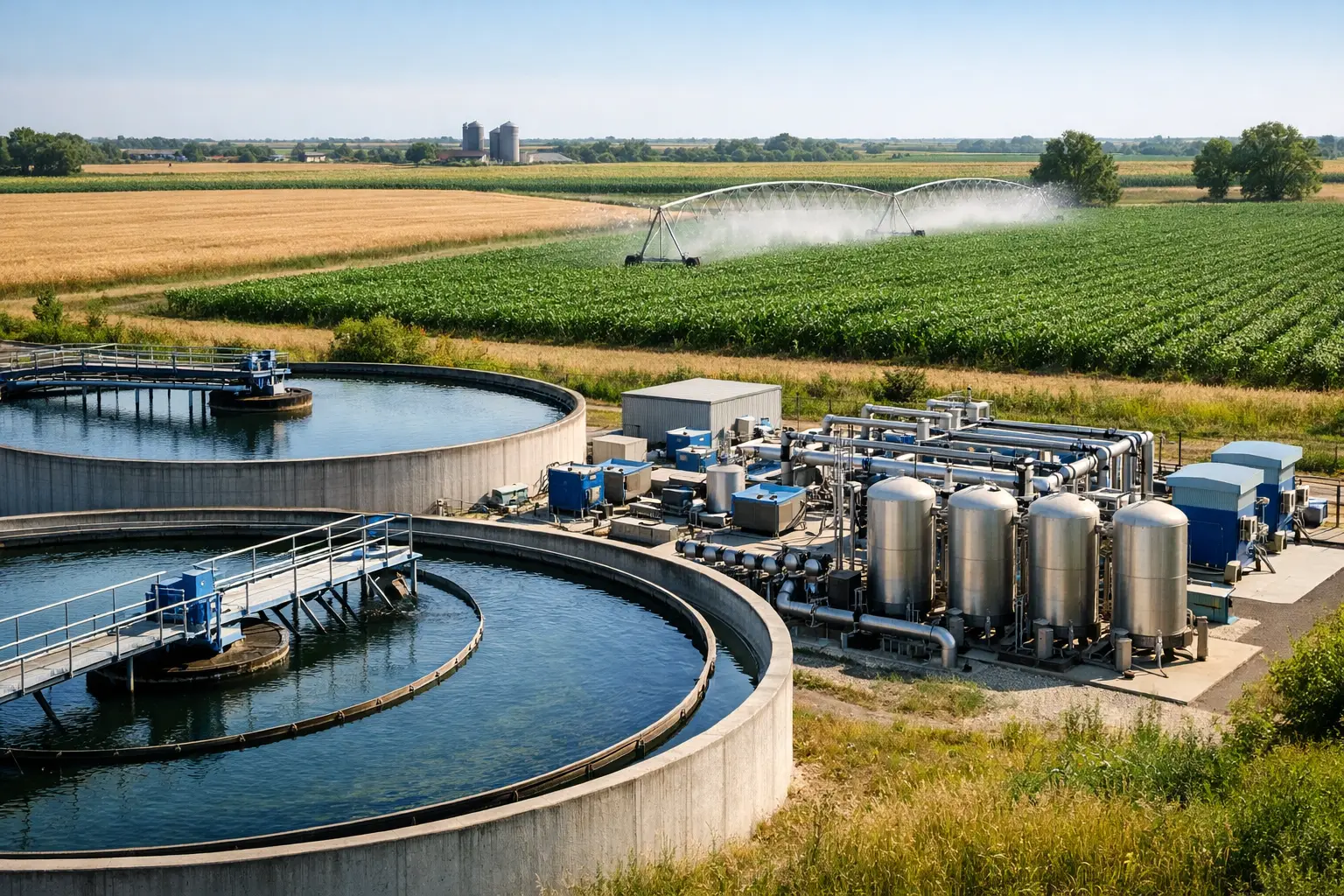
Water Treatment Plant for Agricultural Use
A grower can manage fertilizer rates with precision, schedule irrigation by crop stage, and still lose performance because the water itself is working against the system. When bicarbonates clog emitters, iron stains filters, or sodium accumulates in the root zone, the problem is no longer irrigation alone. It becomes a water quality management issue, and that is where a water treatment plant for agricultural use moves from optional equipment to core infrastructure.
In agriculture, water treatment is not a single technology and not a standard package. It is a designed process built around the source water, the irrigation method, the crop sensitivity, and the farm’s operational goals. A treatment plant for a greenhouse using recirculated fertigation water will look very different from one installed on an open-field farm pumping from a canal, reservoir, or brackish well.
What a water treatment plant for agricultural use actually does
At its most practical level, a treatment plant changes water from a production risk into a more predictable input. That may mean removing suspended solids before they block drip lines, reducing microbial load to lower biofilm formation, adjusting pH to improve nutrient compatibility, or reducing salinity and sodium hazards that limit yield.
The right treatment objective depends on the specific problem. Some farms need cleaner water for filtration protection. Others need chemical correction because alkalinity is too high for stable fertigation. In some cases, the main issue is biological contamination in surface water. In others, dissolved salts make the water unsuitable unless it is blended or desalinated.
This distinction matters because many underperforming systems are overbuilt in one area and underdesigned in another. A farm may invest in advanced filtration when the main yield loss is caused by high chloride or sodium. Another may install acid dosing but ignore organic loading that leads to recurring emitter blockage. Treatment works best when it starts with diagnosis, not equipment selection.
Start with the water analysis, not the equipment catalog
A professional design process begins with a complete water analysis and a realistic understanding of seasonal variation. One test taken in winter is rarely enough. Surface water quality can shift sharply during the season, and well water may also change with pumping intensity, water table movement, or blending practices.
For agricultural decision-making, the analysis should cover physical, chemical, and biological parameters. Suspended solids, turbidity, iron, manganese, hardness, bicarbonates, pH, EC, sodium, chloride, boron, and microbial indicators all influence treatment decisions. Just as important, the interpretation should be agronomic, not only industrial. Water that is acceptable for general utility use may still be unsuitable for a sensitive crop under drip irrigation.
This is where many projects go off course. Industrial water treatment logic often focuses on machinery protection or discharge compliance. Agricultural water treatment must also account for soil structure, nutrient availability, crop tolerance, emitter performance, and long-term root zone conditions.
Main treatment stages in agricultural systems
Most agricultural treatment plants combine several stages rather than relying on one unit operation. The sequence depends on the water source and the target quality.
Pre-treatment usually comes first. This may include screening, sedimentation, or hydrocyclones to remove large particles, sand, and heavy suspended matter. For canal and reservoir water, this stage is often essential because downstream components perform poorly when solids loading is high.
Filtration is the next common stage. Media filters, screen filters, or disc filters are selected based on particle size, organic load, flow rate, and irrigation system sensitivity. Drip irrigation generally requires tighter control than sprinkler systems because emitters are less tolerant to plugging.
Chemical conditioning may then be added. Acid injection is frequently used to reduce pH or neutralize bicarbonates, especially where precipitation of calcium and magnesium salts causes scale. Oxidation and precipitation may be used for iron and manganese removal, but success depends heavily on pH, oxygen availability, retention time, and filtration design.
Disinfection is relevant where biological contamination drives biofilm, pathogen risk, or algae growth. Chlorination is still common, although dose control, contact time, and residual management are critical. UV and ozone can be effective in specific applications, particularly in high-value systems or recirculating water, but they are not universal solutions.
Where salinity is the main limitation, membrane systems such as reverse osmosis may be considered. This can produce a major improvement in water quality, but it comes with higher capital cost, energy demand, concentrate disposal issues, and the need for strong pre-treatment. For many farms, blending lower-quality water with a better source is more practical than full desalination.
Matching treatment to crop and system sensitivity
Not every farm needs the same water quality target. A water treatment plant for agricultural use should be designed around acceptable risk, not theoretical perfection.
High-value greenhouse crops, nurseries, and fertigation-intensive operations usually require tighter control because small water quality problems quickly affect uniformity, nutrient availability, and plant health. In contrast, some field crops under sprinkler or surface irrigation can tolerate wider variation, though soil degradation and long-term salinity risks still need attention.
Crop sensitivity is also non-negotiable. Avocado, citrus, berries, and many greenhouse vegetables respond differently to sodium, chloride, and boron than more tolerant crops. The same applies to irrigation method. Drip systems demand much cleaner water than furrow irrigation because the margin for clogging is far smaller.
This is why a treatment recommendation without reference to crop, soil, irrigation design, and fertigation strategy is incomplete. Water quality is never managed in isolation.
Design mistakes that create expensive problems
One of the most common mistakes is undersizing the plant for peak flow demand. A treatment unit that performs well on paper at average flow may fail during irrigation peaks, exactly when water quality consistency matters most.
Another frequent issue is poor integration between treatment and fertigation. For example, correcting pH upstream may improve nutrient solubility, but if dosing control is unstable, the result can be corrosion, safety risk, or nutrient imbalance. Similarly, a disinfection program that ignores fertilizer compatibility may create precipitation or reduce treatment efficiency.
Maintenance is another weak point. Filters need proper backwash design. Chemical dosing systems need calibration. Sensors need verification. Membranes need cleaning protocols. A plant that is technically sound but operationally neglected will not deliver stable results. In agriculture, simplicity and serviceability often matter as much as treatment performance.
It is also a mistake to focus only on the water entering the farm. Distribution infrastructure matters. Treated water can still lose quality in storage ponds, tanks, and pipelines if retention time, contamination, or algae growth are not controlled.
Economics: when treatment pays back
The return on investment is rarely limited to one line item. A good treatment plant can reduce emitter clogging, improve irrigation uniformity, stabilize nutrient delivery, lower maintenance labor, extend equipment life, and reduce yield loss linked to water quality stress.
Still, economics depend on context. A high-cost desalination unit may be justified in a protected cultivation system growing premium crops with severe source water limitations. The same solution may be uneconomical for broad-acre production. In those cases, partial treatment, blending, source substitution, or agronomic mitigation may be more realistic.
That is why cost analysis should include more than installation price. Energy use, chemical consumption, labor, spare parts, automation level, downtime risk, and expected water quality variation all affect the true operating cost. The cheapest plant to install is often not the cheapest plant to run.
Implementation should be agronomic, not just mechanical
The strongest projects are built around cross-disciplinary planning. Water engineers may size pumps and filters correctly, but agronomic input is needed to define treatment targets that actually support production goals. Soil conditions, crop tolerance, nutrient program, irrigation scheduling, and drainage all shape what the plant must achieve.
For large farms and institutional projects, pilot testing is often worth the effort. A pilot can reveal fouling risk, chemical demand, actual filter performance, and operational constraints before capital is committed at full scale. It also helps teams move from assumptions to measured data.
This approach reflects the broader principle that treatment plants should support management decisions, not replace them. Better water does not fix weak irrigation scheduling or poor nutrition strategy. But it gives the farm a far more stable platform for making those decisions well.
At Cropaia, this is the difference between installing equipment and solving an agronomic problem. The treatment plant should fit the production system, the water reality, and the farm’s capacity to operate it consistently.
The best place to start is simple: know your water, define the actual risk, and design for the field conditions you have, not the ones you wish you had.











About Post Author
