


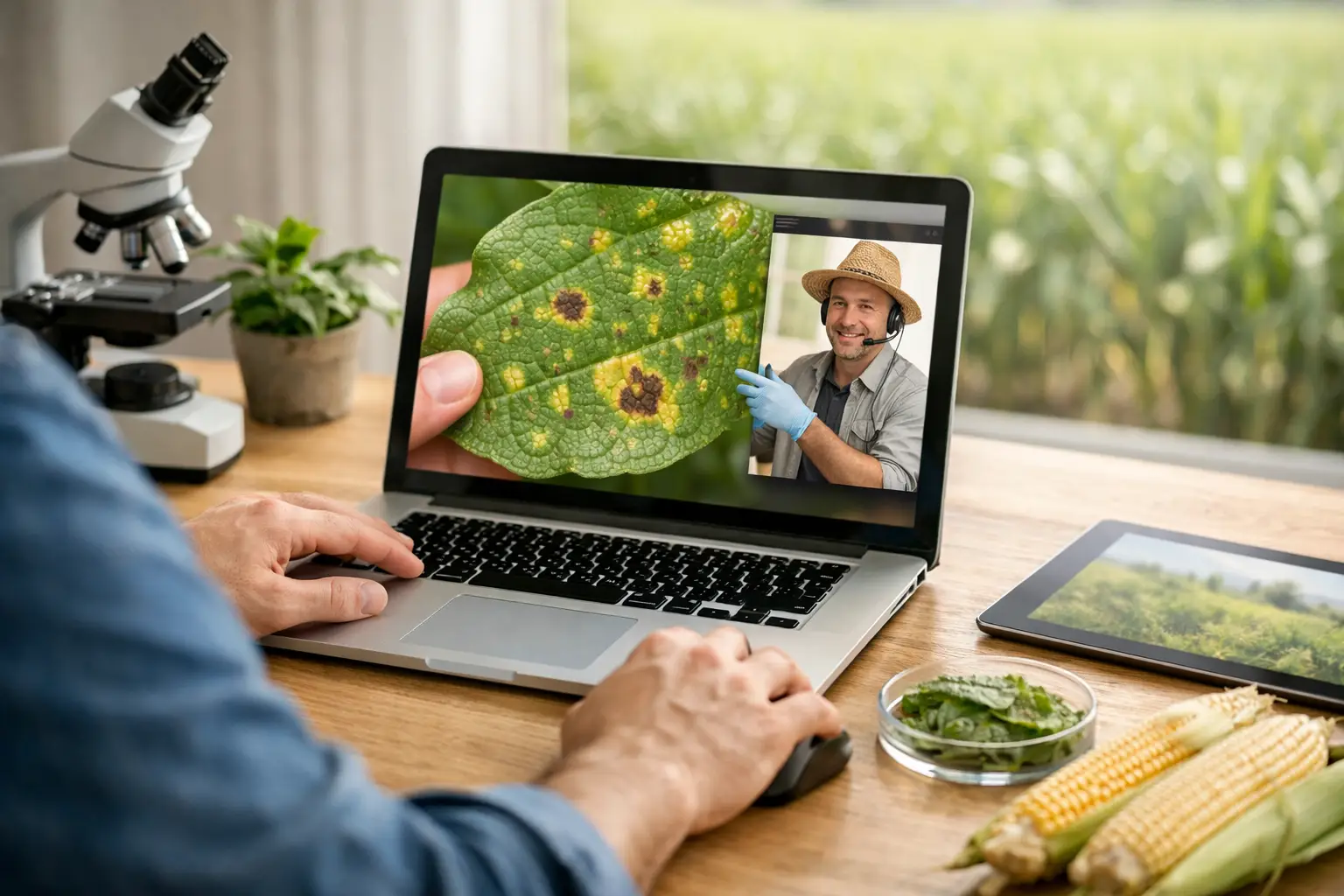
Crop Disease Diagnosis Training Online
A fungicide spray made one week too late can cost yield. A spray made too early, or against the wrong target, can waste money, increase resistance pressure, and still leave the crop exposed. That is why crop disease diagnosis training online has become more than a convenience. For growers, agronomists, and farm managers, it is a practical way to improve decision-making where timing, accuracy, and field interpretation matter.
Disease diagnosis is often treated as a visual skill, but in practice it is a decision process. Symptoms on leaves, stems, roots, and fruit can look similar across very different causes. Nutrient deficiencies can resemble fungal infections. Herbicide injury can be confused with bacterial damage. Environmental stress can trigger secondary symptoms that send scouting teams in the wrong direction. Good training does not just show photos of lesions. It teaches how to separate symptom from cause, how to inspect plants systematically, and how to judge what level of certainty is enough to act.
What crop disease diagnosis training online should actually teach
The value of online training depends on whether it reflects real field conditions. A strong program should build diagnostic thinking, not just memorization. Many professionals already know common diseases in their crops. The challenge is what to do when symptoms are incomplete, mixed, or atypical.
A useful course starts with the fundamentals of plant pathology and symptomology, then moves quickly into field application. Learners need to understand the difference between signs and symptoms, how disease cycles influence what appears in the field, and why timing matters when scouting. For example, a disease may be obvious only at a certain growth stage, or only after environmental conditions have favored rapid development.
Good training also addresses context. The same symptom can mean different things depending on crop stage, irrigation method, weather patterns, soil conditions, varietal susceptibility, and recent spray history. When an online course ignores those variables, it creates false confidence. When it includes them, it helps professionals make better decisions under pressure.
Why online training works for field professionals
For many agricultural teams, the main obstacle is not lack of interest. It is time. Peak disease risk rarely aligns with a quiet period in the season. Online training allows farm managers, crop advisors, and technical teams to build skills without leaving operations understaffed.
That flexibility matters, but convenience alone is not enough. The real strength of crop disease diagnosis training online is that it can standardize how different people in an organization observe and report disease problems. A grower may describe a problem one way, a scout another way, and a consultant a third way. Training creates a common diagnostic language. That improves communication, speeds decisions, and reduces costly misunderstandings.
There is also a scale advantage. Enterprises operating across multiple farms or regions often need consistent disease monitoring protocols. Online training makes it easier to align scouts, agronomists, and managers around the same inspection steps, threshold thinking, and reporting standards. For public-sector organizations and extension teams, this consistency is equally valuable because diagnosis errors at the advisory level can affect many growers, not just one field.
The limits of crop disease diagnosis training online
Online learning is highly effective, but it is not a complete substitute for field exposure. Disease diagnosis remains a visual and observational discipline shaped by real-world variability. Lighting conditions, mixed infections, field history, and symptom progression are hard to fully capture on a screen.
That does not weaken the case for online training. It simply means expectations should be realistic. Online education is best used to build framework, pattern recognition, and decision logic. Field experience is still needed to sharpen judgment. The strongest professional development approach combines structured learning with field scouting, case review, and, when necessary, laboratory confirmation.
This is especially true when the stakes are high. If the outcome will influence major spray decisions, quarantine measures, nursery approvals, or claims about phytosanitary status, visual diagnosis alone may not be enough. Training should help professionals know when they can act confidently and when they should escalate to lab testing or specialist review.
What to look for in a quality course
Not all programs are built for the same audience. Some are introductory and designed for growers who need a working understanding of common diseases. Others are more advanced and better suited to agronomists, consultants, and enterprise technical teams.
The best courses are specific about learning outcomes. They should cover pathogen groups such as fungi, bacteria, viruses, and oomycetes, but they should also explain non-pathogenic causes of crop symptoms. This point is critical. Misdiagnosis often happens because the observer assumes every lesion, chlorosis pattern, or wilting event is infectious. In reality, salinity, irrigation failures, root-zone oxygen stress, nutrient imbalance, and chemical injury can all create misleading visual patterns.
Course quality also improves when learning is case-based. Static disease catalogs have limited value compared with structured examples that ask learners to interpret symptoms, compare likely causes, and choose next steps. The goal is not simply to identify a textbook image. It is to think through uncertainty.
For experienced professionals, depth matters. Training should address disease-conducive conditions, spread mechanisms, host-pathogen-environment interactions, and practical crop protection implications. It should connect diagnosis with management, because a diagnosis only becomes useful when it leads to a better action plan.
How training improves crop protection decisions
Better diagnosis improves more than disease recognition. It supports stronger crop protection strategy. If scouting teams identify problems earlier and more accurately, managers can choose more appropriate products, adjust application timing, improve coverage planning, and reduce unnecessary treatments.
This has direct operational value. Accurate diagnosis can reduce repeat sprays, lower wasted input costs, and protect yield potential. It can also improve resistance management by discouraging broad, reactive pesticide use based on guesswork. In many operations, that alone justifies investment in training.
The benefits extend beyond chemical decisions. Diagnosis can point to irrigation mismanagement, drainage problems, variety selection issues, greenhouse climate conditions, sanitation gaps, and propagation failures. In other words, a disease symptom is often part of a larger agronomic story. Good training helps professionals read that story instead of treating every problem as an isolated event.
Who benefits most from online disease diagnosis training
Commercial growers benefit when they want faster, more confident decisions in the field. Farm managers benefit when they need team consistency and clearer communication with consultants or suppliers. Independent agronomists benefit because diagnostic accuracy affects credibility and client outcomes. Large agribusinesses and public-sector organizations benefit when they need scalable knowledge transfer across regions and personnel.
The training need is not identical across these groups. A grower may focus on symptom recognition, scouting routines, and when to call for support. An agronomist may need deeper work on differential diagnosis and management implications. An enterprise technical team may prioritize standard operating procedures and reporting quality. The right course should match those needs rather than promise the same result for every learner.
This is where provider expertise matters. Organizations with both educational capability and real consulting experience tend to produce stronger training because they understand how disease problems unfold in commercial conditions. Cropaia’s approach, for example, aligns well with professionals who need technically sound, unbiased guidance tied to practical agronomic decisions rather than product-driven messaging.
How to evaluate whether the training is worth it
A simple test is to ask what will be different after completion. If the answer is just that participants will know more disease names, that is not enough. Useful training should improve scouting discipline, reporting accuracy, treatment timing, and confidence in separating likely causes from misleading symptoms.
It should also help teams avoid two common errors. The first is overdiagnosis, where every visual issue is treated as a disease outbreak. The second is delay, where uncertainty leads to inaction until economic damage becomes harder to reverse. The right training reduces both.
Price should be judged against operational risk, not just against other online courses. One incorrect diagnosis in a high-value crop can cost much more than the course fee. At the same time, more expensive training is not automatically better. The better question is whether the instruction is technically credible, practically relevant, and aligned with the crops and responsibilities of the learner.
Crop disease pressure is not becoming simpler. Weather variability, input costs, resistance concerns, and tighter performance expectations are all raising the value of accurate field decisions. Training will not eliminate uncertainty, but it can reduce avoidable mistakes. For professionals responsible for crop health, that is not an academic benefit. It is a practical advantage that shows up in the field, where better judgment still matters most.









About Post Author
