


The Era of Digital-Ag: Opportunities and Challenges
The digital revolution is changing the way agriculture is done all over the world.
Rapid population growth, changes in market demands, depleting agricultural land and significant changes in climate patterns, including much more frequent extreme events – all these are pushing agriculture out of its traditional limits, towards a digital age. This trend is supported by governments worldwide.
‘More or less’ is no longer sustainable
Local know-how and practices are becoming, in many cases, less transferable as conditions change. Many growers find themselves having to adapt to new realities, sometimes even shifting to different crops.
Growers are under increasing pressure to improve efficiency, manage risk, and maintain consistent outcomes under variable conditions.
Decisions are still often based on intuition and experience, which remain valuable, but they are typically applied through “more or less” adjustments.
Under stable conditions, this approach can perform well.
As variability increases, these adjustments lead to less consistent results.
Variety selection, planting dates, water and nutrient requirements, and pest and disease management are merely a few of the decisions that growers have to make. Each of these decisions is influenced by continuously changing environmental conditions.
Making data-driven decisions becomes necessary under these conditions. In practice, the challenge is not access to data, but determining which data actually changes a decision.
Not every data point justifies action. A soil test, an image, or a forecast only becomes relevant when it alters what will be done in the field.
Taking all variables into account, and doing so in real time, exceeds practical human capacity. As a result, decisions are often based on partial information, even when large amounts of data are available.
Can machines and algorithm make better decisions?
The answer is yes, within defined limits.
Algorithms can process large volumes of data and identify patterns beyond human capacity. However, they operate only on the variables they receive and the assumptions built into them.
If key factors are missing or poorly defined, the output can still appear precise while being agronomically misleading.
This means that algorithmic decisions are only as reliable as the structure behind them.
The use of AI in agriculture is expanding, but its effectiveness depends on how well the underlying system is defined.
Models rely on historical and real-time data to identify patterns and generate recommendations. In practice, their value depends on three conditions:
- The data reflects the factors that actually influence the decision
- The model structure aligns with agronomic reality
- The output can be translated into a clear action
When these conditions are not met, models can produce consistent outputs that do not translate into consistent field results.
In practice, the challenge is not only collecting and analyzing data, but ensuring that it leads to consistent decisions under changing conditions.
The challenge of collecting the data
The challenge is not only collecting data, but ensuring that the data is relevant to the decision being made.
Large amounts of data can be collected from sensors, imagery, and field observations. However, most agronomic decisions depend on factors that are only partially captured, or not measured at all.
This creates a gap between what is measured and what actually drives field performance.
The limitations of current technologies should be recognized. The number of parameters that can be measured remains limited, and the extent to which these measurements represent the entire field is often uncertain.
For example:
Can sensors installed on a small number of plants represent the conditions across the whole field?
Crop nutrition decisions may depend on dozens of interacting factors, while in practice only a small subset is measured (e.g., nitrogen status, vegetation indices).
Research by machine learning…
Making sense of the data remains a constraint.
Machine learning allows the development of models that can detect patterns across large datasets. However, these models often identify relationships that are not fully understood or validated under different field conditions.
This creates a practical limitation:
A model can perform well under the conditions it was trained on, but degrade when applied to new environments, crops, or management practices.
As a result, models require continuous validation and adjustment, especially in systems with high variability.
What will drive the adoption of Digital-Ag?
Adoption of Digital-Ag will depend on its ability to improve decisions under real field conditions.
Growers will not adopt systems because they provide more data, but because they make decisions clearer, more consistent, and easier to execute.
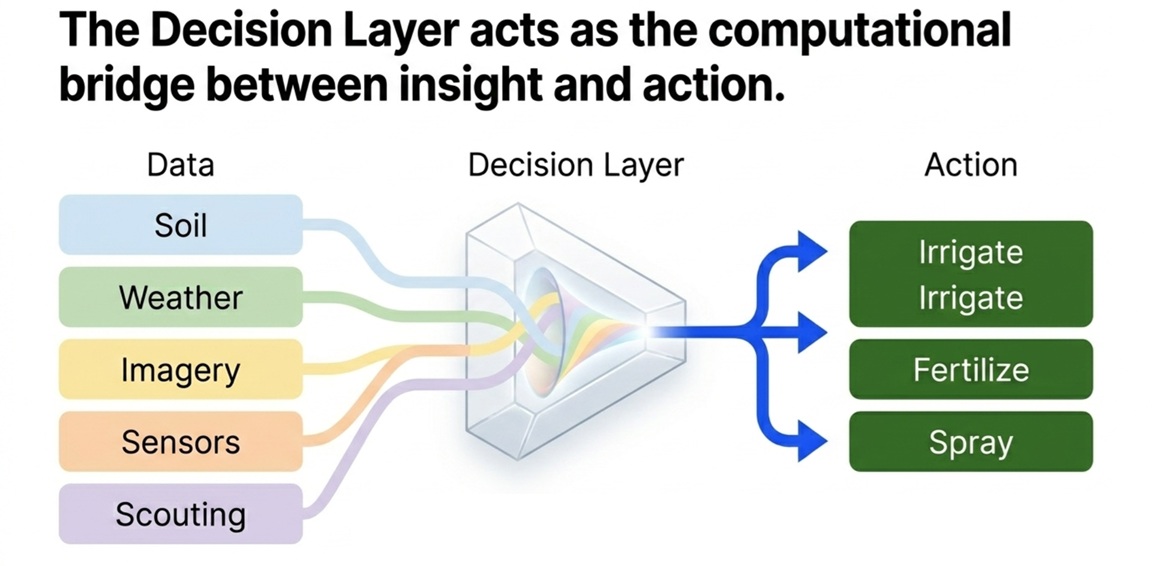
In this context, Digital-Ag becomes a decision layer within the production system.
It connects data, agronomic knowledge, and field operations into a structured process that can be applied across variability.
Systems that achieve this will become part of routine farm management.
Systems that do not will remain underused, regardless of their technical capabilities.
The decision layer acts as the computational bridge between insight and action.











About Post Author
