


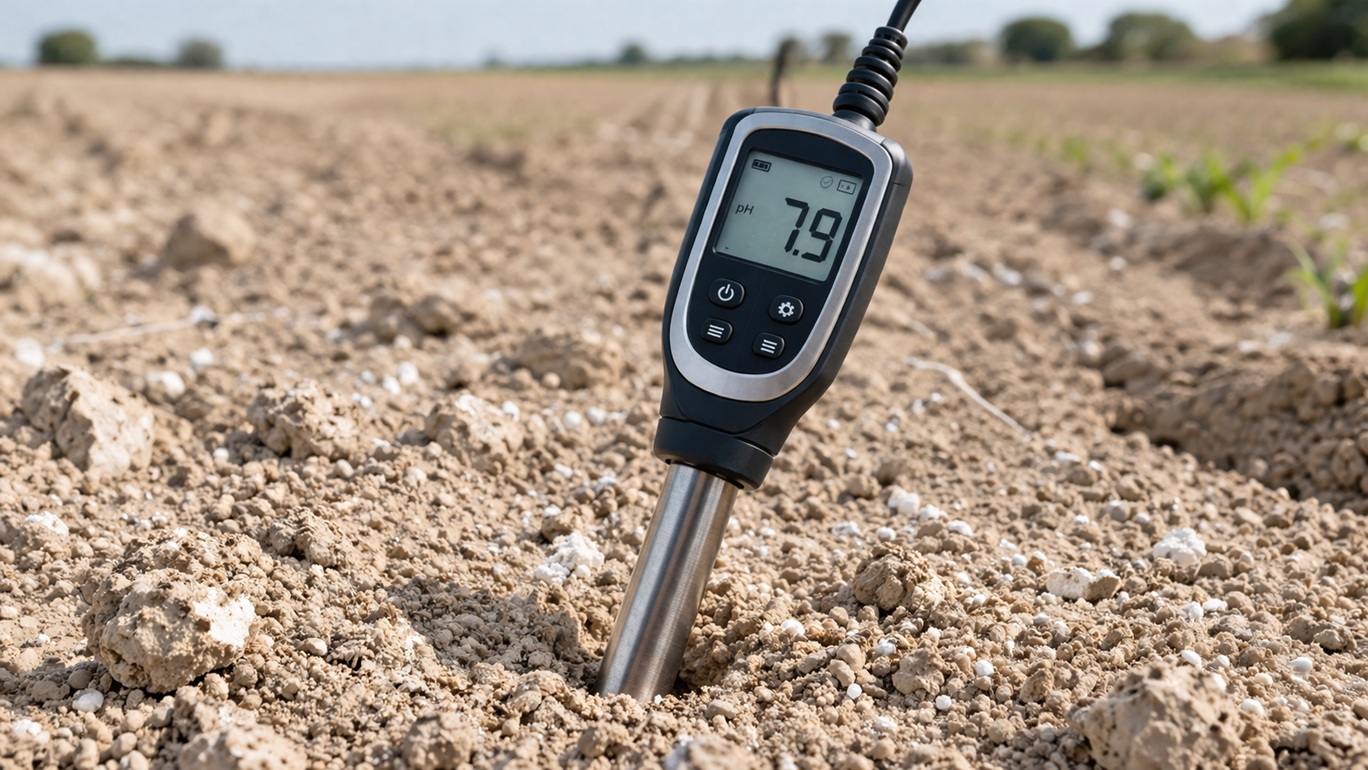
Why most attempts to lower soil pH fail
When soil pH is high, the reaction is almost automatic. Apply sulfur. Inject acid. Change fertilizers.
These recommendations are repeated so often that they are rarely questioned. In many real field situations, they don’t deliver results.
You’re using the wrong sulfur source
There is still confusion around this point.
Applying magnesium sulfate or potassium sulfate will not reduce soil pH. Sulfate (SO₄²⁻) is already the oxidized form of sulfur. It does not generate acidity in the soil.
You are supplying nutrients. Nothing more.
Sulfates don’t release acidity. They don’t generate H⁺, so they don’t change pH.
Elemental sulfur: correct mechanism, limited impact
Elemental sulfur can acidify soil. It is oxidized by microorganisms, producing sulfuric acid and releasing hydrogen ions. That part is correct.
What is usually ignored is the scale of the effect in calcareous soils.
The acid produced reacts quickly with calcium carbonate (CaCO₃). The effect remains localized, and in many cases the overall change in soil pH is too small to detect. It is common to apply sulfur and see no measurable difference in standard lab analysis.
That is not because nothing happened. It is because the soil buffered it.
What the numbers actually look like
Recommendations to “lower soil pH” sound simple until you run the numbers for a typical field:
Soil depth: 20 cm
Bulk density: 1.3 t/m³
Soil mass: ~2,600 t/ha
A common estimate is about 300 kg of elemental sulfur per hectare per pH unit, in non-calcareous soils. If you want to reduce pH by 1.5 units, you would need ~450 kg S/ha (~ lbs/acre).
Converted to sulfuric acid equivalent, that is ~750 L/ha (80 gal/acre) of concentrated acid. This is the scale of the chemical requirement. In calcareous soils, where the carbonate percentage acts as a massive reservoir of alkalinity, changing bulk soil pH is rarely practical or economically viable.
So in a soil with just 5% Calcium Carbonate, you aren’t just fighting a number; you are fighting roughly 130 tons of lime per hectare. 450kg of sulfur is like throwing a cup of water at a forest fire.
Sulfuric acid: effective chemistry, wrong expectations
Sulfuric acid reacts immediately with bicarbonates and carbonates. From a chemical perspective, it works very well.
In soil, the reaction is immediate and short-lived. The acid is neutralized within a very small volume. Even under fertigation, it does not reduce bulk soil pH in calcareous soils.
Its value is in managing water chemistry and the root zone. While it clears the pipes and prevents dripper clogging, carbonates essentially neutralize the acidity before it reaches the edge of the wetted bulb.
Where acidification actually works
Acidification becomes effective when applied through irrigation water to manage the rhizosphere (the root zone).
Example:
To neutralize 53 mg/L of bicarbonates (HCO₃⁻) in irrigation water, for 1 m³ (1000 L) of water:
- Sulfuric acid (98%): ~24 mL/m³
- Nitric acid (60%): ~67 mL/m³
Small volumes, clear effect.
The difference between the acids is not only chemical, but nutritional:
- Sulfuric acid adds sulfate (SO₄²⁻)
- Nitric acid adds nitrate (NO₃⁻)
The real constraint: calcium carbonate
In calcareous soils, the key factor is not just pH. It is the presence of calcium carbonate. This creates a system where any added acidity is immediately neutralized, and the pH tends to return to its original level.
As long as CaCO₃ is present, bulk soil pH does not change in a meaningful way.
Bypassing the soil: foliar and chelate strategies
Since bulk soil pH is often unchangeable, the most effective management strategy is to bypass the soil’s chemical constraints.
When pH is high, micronutrients like iron (Fe), zinc (Zn), and manganese (Mn) become insoluble and unavailable to the roots.
Foliar applications are often the most efficient alternative. By applying nutrients directly to the leaves, you avoid the high-pH environment of the soil where these elements would otherwise precipitate. This provides a rapid response during critical growth stages.
If soil application is required, the type of chelate is critical. Standard EDTA chelates lose stability at pH above 7.0, releasing the nutrient back into the soil. Chelates such as Fe-EDDHA remain stable and available even under highly alkaline conditions.
Where pH management actually works
Changing the entire soil is rarely effective. What can be managed is:
- Irrigation water quality
- The wetted bulb in drip systems
- The root environment
Adjusting nitrogen forms, improving water quality, and managing the rhizosphere often give a clearer response than attempting to change bulk soil pH.
When plants take up ammonium (NH₄⁺), they release hydrogen ions (H⁺) into the rhizosphere. This creates a localized acidification effect around the roots, even when bulk soil pH does not change.
In contrast, nitrate (NO₃⁻) uptake tends to increase pH in the root zone.
This is not a solution for changing soil pH at field scale, but it is a practical tool to influence nutrient availability where it actually matters.
When not to try to fix pH
There are situations where trying to lower soil pH is simply not practical:
- Highly calcareous soils with strong buffering
- Dryland systems without fertigation
- Moderate alkalinity (pH 7.6–7.8) where the cost of intervention exceeds the potential benefit
In many cases, low pH creates more severe limitations due to toxicity and biological disruption than moderate alkalinity does.
Final point
Agronomists and growers often treat high soil pH as something that must be corrected.
In many field conditions, it cannot be corrected in a meaningful way.
What can be controlled is the chemistry around the roots.












About Post Author
